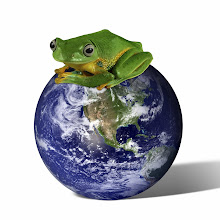
The news reporter stood at the edge of a subdivision last night and pointed at a forest just beyond.
"Soon," he said, "this wooded area will be cleared for 80 new homes, the first application in this part of the county in over a year ...."
The whole story was presented as a great thing, a sign that the economy is turning around.
I shook my head in sorrow for the box turtles, deer, wild pogonia, oaks, maples, pines, bluets, wild azalea, butterflies, black snakes, birds, tree frogs and countless other wild things that will not be consulted in the developers' plans.
And I wondered again: When every last acre of the United States outside of our national parks has been plundered, raped and paved over, when our insatiable greed has spread a dreary shroud of "development" from sea to oil-slicked sea, when Los Angeles borders Boston, when no more "development" is possible because nothing outside of our national parks is left to destroy, how will we keep our sacred economy afloat?
Thursday, February 10, 2011
Termites chewing, chewing

Thursday, November 4, 2010
The Honeybee
The amazing creature that is the honeybee ...
http://www.telegraph.co.uk/science/8104213/Bees-mans-best-friend-provider-and-protector.html
And the comments below the article reference the new (to me at least) idea of being a bee steward. Setting up a hive with no intention to harvest it for honey, just to give bees a chance at survival.
Monday, November 2, 2009
Blue butterflies, red ants, rabbits and cows

Fascinating story!
"In a rare conservation success, a beautiful butterfly species that was headed for extinction has been brought back from the brink, thanks to careful biological observations of the insect’s life cycle. The mysterious disappearance of the Large Blue Butterfly across most of northern Europe was originally put down to its popularity among insect collectors [Telegraph]. Then biologist Jeremy Thomas spent six summers in the 1970s studying the very last colony of large blue butterflies in the United Kingdom, and determined that the butterflies were dependent on one species of red ant for their survival–and those ants were losing their habitat."
full story:
http://blogs.discovermagazine.com/80beats/2009/06/16/a-near-extinct-blue-butterfly-flourishes-again-thanks-to-a-red-ant/
Thursday, August 27, 2009
More reasons why turtles are cool ..
More reasons why turtles are good neighbors...
...and why people who poach or run them over ought to be drop-kicked off the planet:
We already knew that sea turtles are a primary predator of poison jellyfish.
But did you know that having a freshwater turtle in your local pond is more effective against the mosquito population than frogs, birds or even bats?
From somewhere on line:
"In a community in Honduras, each cement water-storage tank received a single 6-12 month old turtle. Turtles did well in the tanks and provided complete control of mosquito larvae (Marten et al. 1992, Borjas et al. 1993). In the USA, turtles were introduced into an experimental enclosure of a roadside ditch in Louisiana, for control of Culex larvae (Marten 2007). The investigator reported that the turtles reduced the number of larvae by 99% by the 5th week of the study.
The need for supplemental feeding and the ability of turtles to move away from the area are two potential issues. The researcher suggests that turtles might be useful in isolated water bodies such as retention ponds where the turtles would have little motivation to leave and supplemental food could be provided if necessary."
Tuesday, June 16, 2009
A dimunitive beauty

When A.R. and I went hiking the other day, I was excited to find one of my old-time woodland neighbors in bloom. It only grows in two places that I know of in the entire forest behind my house. She wanted to pick it but I had to help Her understand that this flower is too scarce to do that.
The little beauty is called Chimaphila maculata (Spotted wintergreen.)
Monday, June 15, 2009
Nature Walk
My little Niece-in-Law, A.R., showed up to Sunday dinner dressed beautifully, as always, in a dress and fancy shoes. I reminded Her that we had talked about a nature walk for the afternoon, so She got Her PaPa to drive Her home to change.
I am a firm believer that for a child to be pyschologically healthy, they need to have times where they learn the importance of being dressed up,clean and mannerly; and they also need times where they are out and about in the dirt and the mud, or learning how to use basic tools to take things apart; or just reveling in being alive. That goes one hundred percent for Girls as well as boys.
I had so looked forward to this nature walk, especially since acquiring Rachel Carson's book recently about helping children to maintain their sense of natural wonder.
I was very honored to be trusted, I a grown man, by myself with the safety and care of this little Girl. That is so rare of a parent these days, with very good reason. You may know, and I certainly know, that I would select the slowest and most painful death possible for myself rather than hurt a child in any possible way -- but a parent cannot read a caregiver's mind. Trust. It was all about trust.
So, finally, we meandered down into the woods. She was far too little to use my big walking stick, so we found Her one that was more Her size. I remembered what Carson wrote and just let A.R. explore and ask questions, rather than be subjected to a litany of botanical nomenclature.
I did point out and identify poison ivy and help her remember the tricks to identifying it: leaves of three; with smooth, not sawtoothed edges.
She found the skull of a raccoon or possum and insisted on bringing it home ... along with a handful of rocks, little freshwater clam shells and a sprig of wild ginger.
We reached the creek and She was a little reluctant to take Her shoes off and dip Her feet into the water -- but again remembering Carson, I knew that She needed that sensory experience. So I didn't press the issue. I dipped my toes in the water first and She eventually did the same.
I let Her clamber around on the creek boulders, ever poised to catch Her if She slipped, biting my tongue as She neared the edge where the water flows a little fast, doing my best to keep the difficult but necessary balance between over-protection and risk.
The hike wasn't all pleasant. She hit up at one point against a nasty branch of multiflora rose and it hurt -- but these experiences are needed, too, the development of woodland awareness -- one always watches where one's feet are going -- critical not just for avoiding thorns but also snakes and ankle-twisting loose rocks or holes.
She came home a little muddy, a little soppy, but full of excitement about Her day and the treasures that She had found. I hope we made some memories, the kind that I treasure from my own childhood.
Friday, March 13, 2009
When is a hog not a hog but in truth a canary?

Thought I'd hook you with that question.
The answer: When the little snuffler is a hedgehog, no relation in truth to piggies at all except that both are mammals. Hedgehogs, argues author Hugh Warwick, also are a warning species, a canary in the coal mine. Their rapid and mysterious decline in their European and Asian homelands, signifies that something is not right in the world.
This is my last post on Warwick's book, "The Hedgehog's Dilemma." But I had to buy that book and I read it cover to cover. I have loved these little beasts since I was a boy in England, when a delightful older couple stopped my family's car on a country road there to prevent us from hitting one. They invited us all in for tea and a friendship began.
Many years later, in a misty Hungarian evening, I rescued a hedgehog myself as it scurried into a roadway. Tell me, what other wild animal can simply be scooped up barehanded -- albeit carefully -- and relocated like that?
Hedgehogs are not creatures of the deep woods, fleeing the sight and sound of man; nor are they citified vermin living off his garbage, like rats or landfill gulls. The inoffensive little insectivores live happily on the edge of his gardens or fields, at home in his world and yet vulnerable to it, scurrying about by night on their little errands, and snoring in the hedgerow by day.
From Warwick:
"Hedgehogs can do more to foment changes in our attitudes towards the environment than almost any other animal. It is only a short walk from thinking of the hedgehog as a rather cute garden visitor to realizing that the roads you drive on to the supermarket or the holidays you take all have an impact on your new-found friend.
"The journey hedgehogs have led me on has taken me from a sentimental love of wildlife through a pragmatic desire to understand something and into something quite special.
"So much can be said without words, so [if you are lucky enough to be in the lands a hedgehog calls home] don't be shy, get down on your hands and knees,lean forward and see what happens as you get nose to nose with a hedgehog. Relish and wallow in the moment of making a connection with the most charismatic creature on the planet."
Wednesday, March 11, 2009


Thursday, August 14, 2008
A shot at lunchtime
My first non-wildflower, non-insect, non-mammal photo, taken at lunchtime today:
Thursday, July 31, 2008

Monday, July 7, 2008
July meanderings
I began my walk on Saturday out in the garden, where the fig tree is entertaining many insect visitors, perhaps in part because of its rank odor -- I never knew these beloved trees STINK in the summer sun.
Speaking of stench, the transplanted Jack in the Pulpit is thriving in the fetid, mosquito-infested woodland seep that continues to dribble in spite of our drought. This is its seed cluster.
Little further on grows "lizards tail," which also likes ooey-gooey damp places, but at least has the decency to produce a surprisingly fragrant scent, if you can stop smacking mosquitoes long enough to appreciate it. 
I like this old sycamore tree, which has survived a hurricane and several massive floods, and that's just in the few short years that I have known it. It grasps the sandy creek edge with the determination of a steely soldier fighting for his foxhole -- its gnarled roots have character!
Here is the creek, almost dried up now -- but just a few years ago, in a great storm, coursing with such fury as to tear out a bridge and drown a Woman trapped in Her car.
Again, in spite of our drought I was surprised to find a flow of water coursing through the green blanket of poison ivy in the power-line cut -- and some friendlier ferns. I don't know what type. I'm not a fern expert. 
This smoke tree, mimosa something-or-other, is invasive but hard to hate, with its soft, pink blossom like the tutu of some little wood nymph. 
Trumpet vine! First time I have seen it in these woods.
Here is a mystery. I vaguely remember finding a catalpa tree near this spot last year, as witnessed by the long "beans" that hung down from it at the time. Catalpas have huge leaves as this tree does. Are these sticky green fruits going to lengthen into pods during the summer, meaning that I have rediscovered the catalpa? Or is this a different tree?
Friday, July 4, 2008
A mystery
I kept my promise to myself today. I grabbed my camera and the sturdy walking stick that my dad made for me about five or six years ago and despite the heat, I went walking.
I did not expect to find much worth photographing, not as long as this furnace heat and deadly dessication persists. But there was still much to see, and I will share it with you all on Monday -- I can't download pictures from that camera onto my home computer.
Far from my home, past the power line cut where poison ivy grows thick and green like the devil's garden, out of the groves of beeches and holly and in the bright light of an old industrial area where young pines now grow, filling the air with their unmistakable sun-warmed fragrance, I found a strange tree.
It has huge, ovate, untoothed, pubescent leaves. I forget to check whether they were opposite or alternate. And it bears a fruit, an odd, green (at least for now)fruit as big (at least for now) as a small plum but more oblong in shape, smooth and rather sticky.
It is a complete mystery to me. It's not a pawpaw or anything in the rose family, like a crabapple. It's not a pod, so couldn't be a catalpa or anything in the acacia family, like a locust bean. It's not a nut, not prickly like a chestnut or a chinqapin. It's not a cluster or a drupe, like mountain ash or sumac.
Wednesday, June 11, 2008
a traveler encountered
The hundred-degree heat shimmered on the pavement and at first I thought it was a breeze-blown leaf bouncing across the road.
Then knowledge set in and reflexes, too. I found myself stopping the car so hard by the side of the road that I almost wrenched the gears.
Before I knew it, I was safely back in my car and only then did I realize that my heart was pounding and that I was feeling great relief to have accomplished my sudden mission.
For in my southward travels down this road at the city's edge, I had met an eastward traveling turtle. Perhaps he would have safely crossed this semi-quiet highway, perhaps not.
I wonder if the scorching hot asphalt was hurting his little feet. Perhaps at least that was encouraging him to hurry. Maybe that accounted for his odd little bouncing gait.
I will always remember the sight of him, kicking his little legs as I picked him up and carried him to a field in the direction that he was going. With a turtle, you must always put him down in the direction that he is going or his little instinct compass will cause him to turn and head right back into danger.
I will remember how quickly, for a turtle, he scrambled away into the grass, and how good I felt that I hadn't talked myself out of helping him.
He was big, for a box turtle. They say these creatures can live to be 100 years old, if they don't get run over or eaten. So this little fellow might be as old or older than I am.
He traveled on to his evening agenda and I to mine.
Wednesday, May 21, 2008
Flower power
I turned over some soil by the side of the house yesterday and planted Oriental poppy seeds. Two years from now, they will look like this:
Poppies and man have a love-hate relationship. They are the state flower of California, waving in the warm breeze -- and the illegal, national industry of Afghanistan, their juices being squeezed to make heroin or morphine, the profits being used to finance Taliban terror -- and to feed a poor peasant's family.
In Flanders Fields they famously grow, amongst the graves of the World War I dead. Elsewhere, more prosaicly speaking, their little black seeds lend crunch to a bagel.
In the hospital, their powerful synthetic cousins knock out pain.
I met poppies first in the pages of literature, when I was a kid, reading of the blooms that Dorothy encountered in Oz, that lulled her to slumber. It was a very strange chapter. I was young enough to have no understanding how a flower could possibly have such power.
Saturday, May 17, 2008
Nurses and Eliasomes
Last night, the in-laws, Sweetie and I drove to see a young relative of ours go through Her pinning ceremony for Nursing School.
We heard a great speech that perfectly explained to us non-nurses what these students have gone through to obtain their degree.
This morning, I will head outside and plant the dozen bloodroot (sanguinara canadensis)seeds that I harvested yesterday from the little plants that I started from a root a few years ago.
C. loves nursing and She will be a fine one. Her personality is perfectly adapted to the work that will be required of Her.
So it is with nature, too: each species adapts to a particular niche and fills it perfectly.
Bloodroot is an ephemereal. That means it pops up briefly in the spring, absorbing the early sunlight of the forest before the trees leaf out. This is a niche in time and place that most other plant species don't exploit.
The seed includes an odd little white tail that looks like a little worm. It's called an eliasome. To an ant, crawling about the leaf litter in May, the eliasome is a gift from heaven, an anty Dunkin Donut that it is quite happy to haul away home, with the seed included. Thus the seed is assured locomotion to a new place and proper burial.
One cannot simply dry this seed and then plant it any old time or place, like carrots or beans. One has to be mindful of the specific conditions to which the plant is adapted: moist, cool soil, with a minimum of sunlight.
So I must sow today, before the seeds dry out, in a place where they will not be disturbed during the long summer months. Only in the fall will they finally awaken and only in the spring will I see the plants emerging from the soil.
This is what they look like:
Saturday, April 26, 2008
Exhausted
I spent the morning with my Sweetie and my Niece-in-law, feeding ducks and saving tent caterpillars from the sidewalk at a leafy local university. How do you tell an earnest six year old that tent caterpillars don't grow up to be lovely butterflies -- that they are ravenous pests which can strip an entire tree bare?
Then finally, we dropped Her off at home and it was my time! Time, after a week of no time, to tackle some outdoor projects.
First order of business: attempt to tame the damnable honeysuckle that is blanketing the woods behind my back yard and extending its tendrils even into the lawn. The problem is that the honeysuckle has formed an alliance with thorny bramble vines, weedy mulberry saplings and with the rusty ruins of the fence that the hurricane destroyed a few years ago.
So it was slow going -- you couldn't yank the honeysuckle barehanded or you'd get a palmful of thorns. You couldn't yank at all where the mulberry was anchored -- that had to be dug out. And that stupid fence, over and in which the whole mess was tangled, has already slashed a gash in my jeans, not to mention my hands.
But with a saw, a pair of clippers and a shovel, I beat back the horde.
With what remained of my energy, I dug a hole near the house and finally, finally, finally planted the peach tree.
Then I sat there on the grass, covered in filth, completely, totally, blissfully exhausted.
Tuesday, April 22, 2008
Bizzare photo of the day

Giant jellyfish are invading Japan.
(Parents, this is what can happen if you let your children band birds. They grow up to put tags on all sorts of creatures.)
http://news.nationalgeographic.com/news/2006/01/0119_060119_jellyfish.html
Saturday, April 5, 2008
Bleech.

Because there are no deer in "my" woods behind my house, I get spoiled. I can wander there with impunity and bring home nothing but memories.
Alas, other Virginia woods have lots of deer. And where there are deer, there also lives a certain disgusting, repulsive, nasty little parasite called a tick.
If you've never been tick-bit, count your blessings. Unlike a mosquito, which dines on you and then skedaddles to avoid being smacked, a tick intends to ride you for the long haul, sucking and swelling. Eventually, nicely engorged, the thing will finally fall off, but who wants to wait that long?
So you have to pull it out. That's no job for the squeamish.
Last night, something didn't feel quite right. I examined what at first glance appeared to be a mole, where I didn't remember having a mole before. Sure enough, twas a tick, probably picked up when I embraced the ground the other day taking those arbutus photos.
Experts advise that a tick should be removed firmly but not too quickly and not by burning it with a match head or other folk remedies. You don't want the thing's head by which it is attached to you, to break off and be stuck in your skin.
Evolution has given us wonderful creatures like the blue whale and ladyslipper orchid. It has also given us fleas, tapeworms and ticks.
Saturday, March 29, 2008
Calling upon a neighbor ... too late

This is what I missed this week.
This is not my picture. It is borrowed from all-creatures.org.
On a heap of humus above a giant boulder, within the woods behind my home, this leafy being dwells. I met it for the first time last year, and the sight made me gasp, it really did. I'm not being overly dramatic. I am truly in love with life, in all its myriad forms -- and this one was new to me. Nowhere else in these woods have I ever seen it.
It raised small, white flowers bravely from the leaf litter into the still-chilly spring air. They gave off a faint, sweet fragrance. I surrounded it with a little border of rocks, so that I could find the spot again.
Scarcely a week later, the flowers were gone and the leaves had wilted.
For this is Saxifraga virginiensis, Early Saxifrage, one of the first wildflowers of spring, and like other ephemereals, its life above ground is oh-so-brief. The roots persist; through summer's heat and winter's worst they wait, for just that moment in the early months of the year to display their floral glory.
Saxifrage means stone-breaker in Latin, for this little beauty loves to grow upon rocky slopes, where no doubt its roots do help, by infinitesimal degrees, to break down even the biggest boulders.
This year, I missed the show. I had been meaning to get back out there to that spot, but I miscalculated, I waitdd too long. And today, when I finally made my way back to the circle of stones, the flowers were already shriveled and yellowed, the leaves wilting away.
So this is not my picture. It is borrowed. Perhaps next year I will take my own.
Thursday, February 7, 2008
A most amazing excerpt
In the aforementioned "Folklore of Plants" is found this excerpt that I want to remember long after I have returned, sorrowfully, this old book to the library. I am tempted to tell them that, umm, I lost it and pay the penalty.
"Speaking of the Victoria Gardens in Bombay, [Dr. George Birwood] says: A true Persian in flowing robes of blue, and on his head his sheep-skin hat -- black, glossy, curled, the fleece of Kara-Kal [sic] -- would saunter in, and stand and meditate over every flower he saw, and always as if half in vision. And when this vision was fulfilled and the ideal flower he was seeking found, he would spread his mat and sit before it until the setting of the sun, and then pray before it, and fold his mat again and go home.
"And the next night, and night after night, until that particular flower faded away, he would return to it, and bring his friends in ever-increasing troops to it, and sit and play the guitar or lute before it, and they would all together pray there, and after prayer still sit before it sipping sherbet, and talking the most hilarious and shocking scandal, late into the moonlight; and so again and again every evening until the flower died.
"Sometimes, by way of a grand finale, the whole company would suddenly rise before the flower and serenade it, together with an ode from Hafiz, and depart."
I hope that it does not detract from the stirring beauty of this story to point out that a "true Persian" would be an Iranian today. Perhaps this is a side of that ancient people that is largely unknown in the West.